A World in Permanent Dusk
At the top of the twilight zone, around 200 meters, there's still enough light to see—a deep blue glow filtering down from above. By 500 meters, only 1% of surface light remains. At 1,000 meters, the bottom of this zone, sunlight is effectively absent. This gradient of diminishing light creates a realm where vision still matters, but where making your own light becomes increasingly important.
The twilight zone is too deep for conventional scuba diving and too shallow for most deep-sea research. It exists in a technological gap that left it understudied until new tools—autonomous vehicles, acoustic surveys, and eDNA sampling—finally revealed its secrets.
What You'll Discover
- Why an estimated 90% of twilight zone animals produce their own light
- How billions of organisms undertake Earth's largest daily migration
- Why this zone may store as much carbon as all the world's forests
- What life looks like in a realm where sunlight fades to almost nothing
Pause & Predict
An estimated 90% of twilight zone animals can produce bioluminescence—making this the most luminous environment on Earth. In a realm where sunlight fades to near-nothing, life has invented its own illumination. Flash a light here, and the water erupts in answering sparkles. This living light serves countless purposes: luring prey, attracting mates, confusing predators, and even erasing shadows through counterillumination.
The answer is approximately 90% — nearly all twilight zone animals can produce their own light! This makes it the most luminous environment on Earth. While 25% or 50% might seem reasonable, bioluminescence is actually the norm here, not the exception. When sunlight fades to near-nothing, life has invented its own illumination. This living light serves countless purposes: luring prey, attracting mates, confusing predators, and even erasing shadows through counterillumination.
Bioluminescence: Life Makes Light
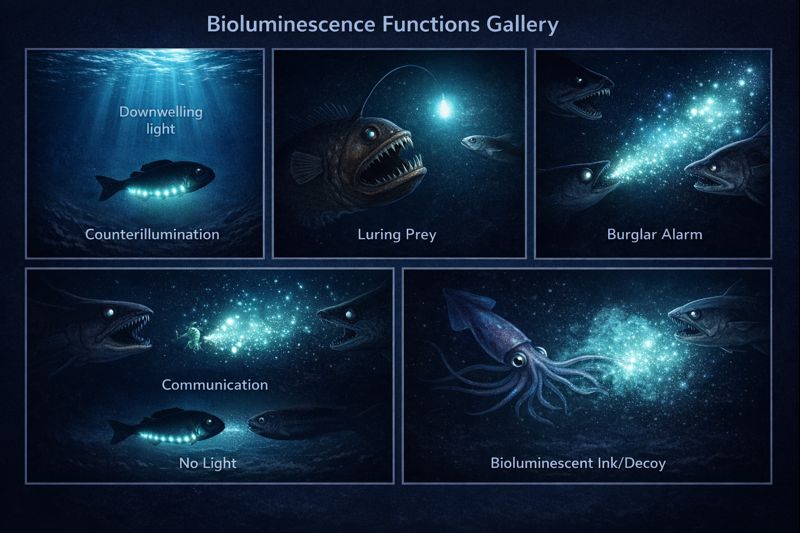
In a realm where sunlight fails, life has invented its own illumination. Flash a light in the twilight zone, and the water erupts in answering sparkles. Bioluminescence serves many purposes: luring prey, attracting mates, confusing predators, communicating with others, and—through counterillumination—erasing shadows.
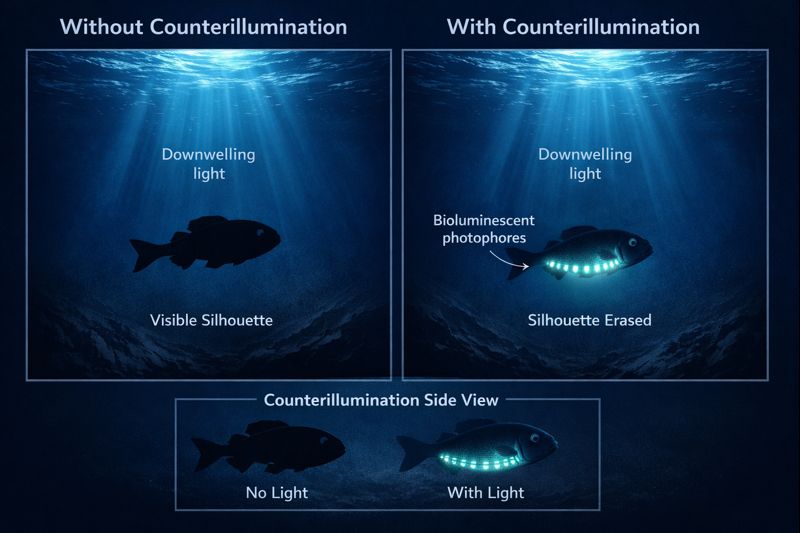
The variety of bioluminescent strategies is remarkable. Hatchetfish use photophores on their bellies to match the dim light from above, erasing their silhouette when viewed from below. Anglerfish dangle glowing lures. Squid release bioluminescent "ink" clouds to confuse predators. Flashlight fish use light to coordinate schools in the darkness.
Bioluminescence Strategies
The twilight zone's living light serves countless functions, each evolved to solve specific survival challenges in this dim realm.
Apply It: Design a Twilight Zone Species
You're designing a small fish (15cm long) that lives in the twilight zone at 400 meters depth. It feeds on sinking particles and small zooplankton. Which adaptation would be MOST critical for its survival?
Large, sensitive eyes are critical at 400 meters! At this depth, you're catching the last whispers of surface light plus the constant sparkle of bioluminescence. Many twilight zone fish have eyes that take up a significant portion of their head—some even have tubular eyes that point upward to spot silhouettes against the dim surface glow. These oversized eyes gather every available photon, giving your fish a crucial advantage in detecting both prey and predators.
Counterillumination is one of the twilight zone's most elegant adaptations! By producing dim light from photophores on its belly that matches the faint downwelling light from above, your fish erases its silhouette when viewed from below. Predators looking up see no shadow—just uniform dimness. Hatchetfish are masters of this technique, constantly adjusting their belly lights to match changing light conditions as they migrate vertically. This is exactly the kind of sophistication the twilight zone demands!
Red coloration is a legitimate twilight zone strategy—red light doesn't penetrate deep, so red animals appear black in the blue twilight. However, this only works against predators that lack red-sensitive vision. Some twilight zone predators (like dragonfishes) have evolved red bioluminescence specifically to illuminate red prey that think they're invisible! It's an evolutionary arms race. Red coloration is most effective in the deeper parts of the twilight zone and into the midnight zone where no red light remains at all.
An expandable jaw and stomach is a brilliant adaptation—but it's more critical in the deeper midnight and abyssal zones where food is truly scarce and every meal might be your last for weeks. At 400 meters in the twilight zone, you're still getting a steady rain of sinking particles and migrating zooplankton. While having flexible feeding abilities never hurts, the twilight zone offers relatively more food opportunities than deeper zones. This adaptation becomes increasingly valuable the deeper you go!
Creatures of the Twilight
The twilight zone harbors a strange menagerie. Many creatures here have huge eyes to capture every photon. Others have abandoned vision entirely. Some are transparent, some silvery, some dark red (which appears black in the dim blue light). Body shapes tend toward the strange—spines, elongated forms, and features adapted for a world of perpetual dusk.
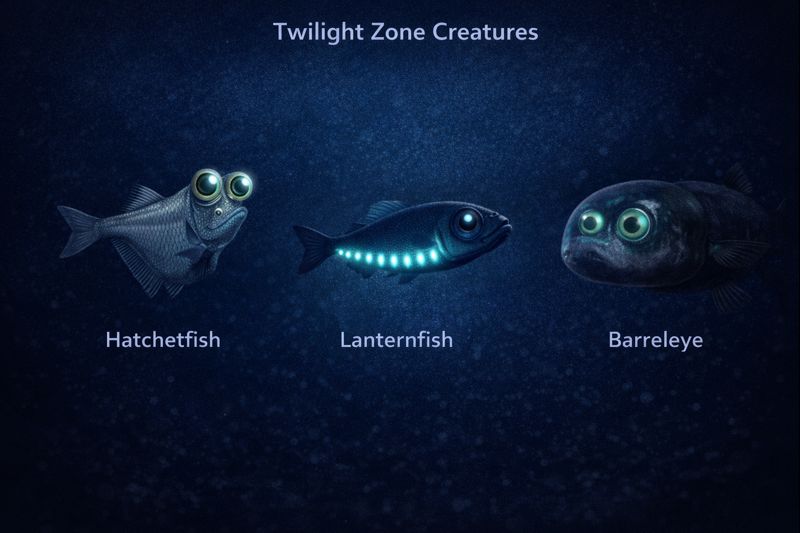
Lanternfish may be the most abundant vertebrates on Earth—billions upon billions of small, bioluminescent fish that form the backbone of twilight zone food webs. They're eaten by tuna, swordfish, seabirds, and marine mammals, transferring energy from the depths to creatures we know better.
Connection Challenge
Explain how bioluminescence works in the twilight zone. Tap key phrases below to build your answer:
Organisms produce bioluminescence when luciferin combines with luciferase and oxygen to create cold light. This light serves multiple purposes: confusing predators by creating decoys or burglar alarms, luring prey closer with glowing displays, or communicating with potential mates through species-specific light patterns. Some animals produce light themselves; others host bioluminescent bacteria.
Your answer might have focused on different functions and that's perfect! The key is understanding that in the twilight zone, producing your own light is as important as having eyes to see it.
The Great Vertical Migration
Every day, as the sun sets, billions of animals rise from the twilight zone toward the surface. They spend the night feeding in the productive surface waters under cover of darkness, then descend at dawn to hide in the safety of the deep. This diel vertical migration is the largest animal movement on Earth—so massive it shows up on sonar as a "false bottom" that rises and falls with the light.
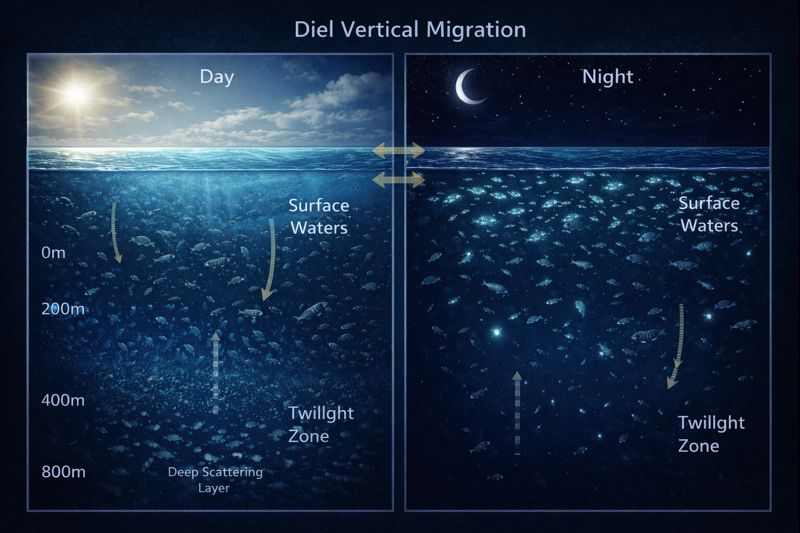
The scale is staggering. Scientists estimate that biomass equivalent to the weight of several billion people makes this journey twice a day. The migration is so massive that sonar operators initially mistook the dense layer of animals for the seafloor itself—a phenomenon they called the "deep scattering layer."
The vertical migration represents a fundamental trade-off: risk versus reward. The sunlit zone offers abundant food but also exposes organisms to visual predators. The twilight zone offers darkness and safety but little food. By migrating, organisms get the best of both—feeding at night when predators can't see them, then retreating to safety during the day.
DVM has profound impacts on ocean ecology and global carbon cycling. These migrating organisms are essentially a biological conveyor belt, transporting carbon from the surface to depth. They feed on phytoplankton and zooplankton in the sunlit zone, then excrete waste and respire CO₂ in deeper waters. When they die, their bodies sink, carrying carbon to the deep sea where it remains sequestered for centuries.
This "active transport" of carbon by migrating organisms significantly enhances the ocean's biological pump, helping regulate Earth's climate. Research suggests that diel vertical migration may transport as much as 1 billion tonnes of carbon to the deep ocean annually—a climate service worth understanding and protecting.
Check Your Understanding
Based on what you just read about diel vertical migration, which statements are accurate? (Select all that apply)
DVM is indeed the largest daily migration on Earth, with billions of organisms ascending at dusk to feed safely at night. This migration transports roughly 1 billion tonnes of carbon annually to the deep ocean. While moon phase can influence some marine behavior, DVM is primarily driven by the daily light cycle, not lunar phases.
Conditions in the Twilight
The twilight zone is defined by rapid change. Temperature drops dramatically through this zone, from about 20°C at the top to around 4°C at the bottom—the permanent cold of the deep ocean. Pressure increases from 20 atmospheres at 200m to 100 atmospheres at 1,000m. Migrating animals experience these extreme changes twice daily.
The Carbon Highway
The twilight zone plays a crucial role in Earth's climate. Carbon that enters this zone—whether as sinking particles or in the bodies of migrating animals—tends to stay in the deep ocean for centuries. The twilight zone is a critical waystation in the biological pump that sequesters atmospheric carbon.
"The twilight zone may sequester as much carbon as all the world's forests. Disrupting it could release billions of tonnes of CO₂ into the atmosphere."
This makes the twilight zone not just ecologically important but climatically critical. Yet it's increasingly targeted for fishing as shallower stocks decline. The mesopelagic fish that drive the carbon pump could become the next frontier of industrial fishing—with consequences we don't yet understand.
The twilight zone is the ocean's hidden engine—a vast reservoir of life that connects surface and deep, drives global carbon cycles, and feeds countless predators. It remained unknown until recently, and we're only beginning to understand what we might lose if we exploit it carelessly.
Knowledge Check
Validate your understanding of the twilight zone