Where crushing pressure meets absolute darkness, and life evolves beyond imagination
1,000—4,000m
Depth Range
400
Atmospheres Pressure
75%
Of Ocean Volume
Below 1,000 meters, sunlight never penetrates. This is the midnight zone—the bathypelagic and abyssal realms—where darkness is absolute, pressure is crushing, temperatures hover near freezing, and food is scarce. Yet life thrives here in forms that seem more alien than anything we might find on other planets. The deep sea is Earth's largest habitat, and we've explored less of it than we have the surface of Mars.
What You'll Discover
In this guide, you'll explore:
How life survives crushing pressures that would destroy human-made submarines
Why this zone is called "Earth's largest desert" despite being full of water
What hydrothermal vents reveal about the origins of life on Earth—and beyond
How the deep sea remains Earth's least explored frontier, less known than Mars
The Crushing Dark
The midnight zone is defined by absence—absence of light, absence of warmth, absence of easy food. What it doesn't lack is pressure. At 4,000 meters, pressure exceeds 400 atmospheres—equivalent to having a large elephant stand on every square centimeter of your body. Human submarines require massive engineering just to survive minutes at these depths.
Ocean Zones by Depth
☀️ Sunlit Zone (Epipelagic)0-200m
🌅 Twilight Zone (Mesopelagic)200-1,000m
🌑 Midnight Zone (Bathypelagic)1,000-4,000m
🕳️ Abyssal Zone4,000-6,000m
The Last Frontier
More humans have walked on the moon than have visited the deepest ocean trenches. We have better maps of Mars than of our own seafloor. The midnight zone contains the largest habitat on Earth, yet it remains almost completely unexplored. Every expedition discovers new species—sometimes dozens per dive.
Life here has had to solve problems that surface creatures never face. How do you find food when the nearest meal might be kilometers away? How do you reproduce when potential mates are scattered across vast, featureless darkness? How do you avoid becoming prey when you can't see predators coming? Deep-sea creatures have evolved solutions that challenge our understanding of what's biologically possible.
🤔
Pause & Predict
You just learned the midnight zone is Earth's largest habitat, yet remains almost unexplored. Before reading the next section, what do you think is the PRIMARY limiting factor for life in the midnight zone?
Pressure - organisms can't survive the crushing force
Darkness - no light means no vision or navigation
Food scarcity - energy is extremely limited
Cold temperature - near-freezing water stops metabolism
✨ Exactly right!
Food scarcity is the defining challenge of the midnight zone. While organisms have evolved remarkable adaptations to handle pressure, darkness, and cold, energy remains the ultimate constraint. Most food arrives as "marine snow"—a constant drizzle of dead organic matter from above. Occasionally a whale carcass provides a bonanza, but such events are rare. Everything about deep-sea life—slow growth, enormous mouths, minimal movement—reflects this perpetual energy crisis.
🔍 Not quite — but good thinking!
The answer is food scarcity. While pressure, darkness, and cold are all extreme challenges, organisms have evolved remarkable adaptations to handle them. Food, however, remains the ultimate constraint. Most energy arrives as "marine snow"—a slow drizzle of dead matter from above. Everything about deep-sea life reflects this perpetual energy crisis: slow growth, enormous mouths that can swallow prey whole, minimal movement, and metabolisms slowed to a crawl.
Extreme Conditions
The midnight zone presents life with four simultaneous extremes that would be instantly fatal to most surface organisms.
Pressure
Crushing Force
At 4,000 meters, pressure reaches 400 atmospheres. Gas-filled structures collapse. Proteins denature. Only specifically adapted organisms can function here.
Light
Absolute Darkness
Not a single photon of sunlight reaches here. The only illumination is bioluminescence—living light created by the creatures themselves.
Temperature
Near Freezing
Water temperature hovers between 0°C and 4°C throughout the deep ocean—cold enough to slow metabolism to a crawl.
Food
Scarce & Unpredictable
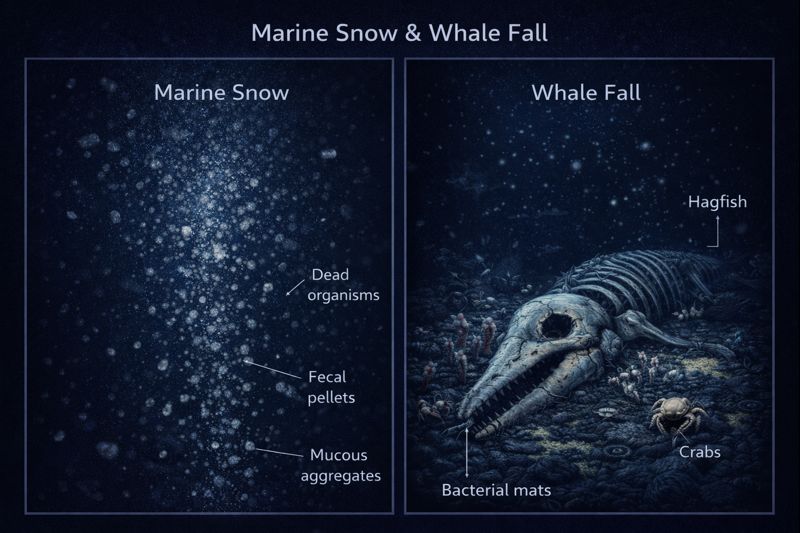
Most food arrives as "marine snow"—a constant drizzle of dead organic matter. Occasionally, a whale carcass provides a feast that can sustain a community for decades.
Pressure Comparison
At the surface: 1 atmosphere. At 1,000m (top of midnight zone): 100 atmospheres. At 4,000m (bottom): 400 atmospheres. At the deepest point on Earth (Mariana Trench, 11,000m): 1,100 atmospheres—equivalent to 50 jumbo jets stacked on a person.
Figure 1
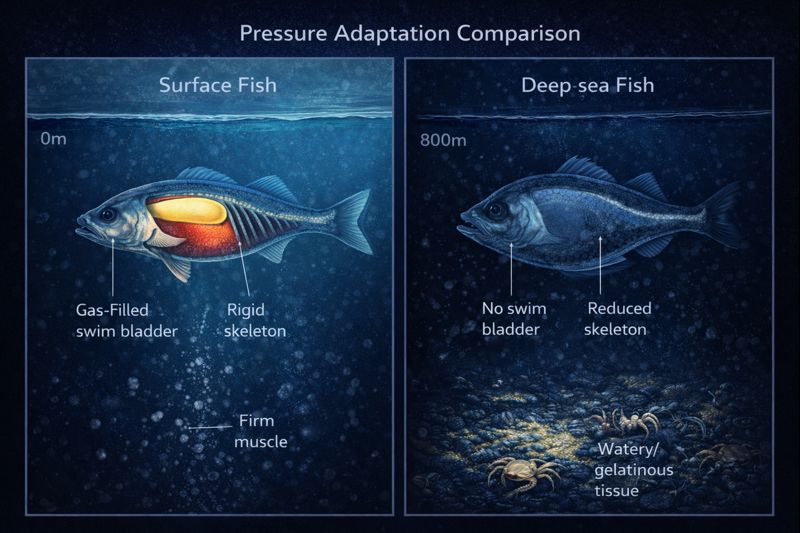
Pressure adaptation comparison: surface fish rely on gas-filled swim bladders, rigid skeletons, and firm muscles. Deep-sea fish eliminate compressible gas spaces, reduce skeletal density, and replace firm tissue with watery, gelatinous flesh that equalizes pressure inside and out.
Survival Strategies
Deep-sea organisms have evolved extraordinary adaptations to handle these extremes. Many solutions seem counterintuitive or impossible until you understand the physics and chemistry of the deep.
Pressure Adaptation
Flexible Bodies
No gas-filled swim bladders (they'd collapse). Gelatinous tissues without rigid structures. Some deep-sea fish have watery flesh that's the same density as seawater—achieving neutral buoyancy without effort.
Energy Conservation
Slow Everything
Extremely slow metabolism. Minimal movement. Some deep-sea fish can go months without eating. When food arrives, expandable stomachs allow them to consume prey larger than themselves.
Finding Food
Extreme Adaptations
Enormous eyes to detect any trace of bioluminescence. Or no eyes at all, replaced by chemical and tactile senses. Lures that glow to attract prey. Mouths that unhinge.
Reproduction
Desperate Measures
When mates are rare, some species have evolved extreme strategies. Male anglerfish fuse permanently to females, becoming parasitic sperm banks. Others broadcast enormous numbers of eggs, hoping a few survive.
Figure 2
Food reaches the midnight zone through marine snow—a constant drift of dead organisms, fecal pellets, and mucous aggregates—and rare bonanzas like whale falls, where a single carcass can sustain communities of hagfish, crabs, and bacterial mats for decades.
🎯
Apply It: Design a Midnight Zone Predator
You're designing a predator for the midnight zone at 2,000 meters depth. Food is extremely scarce, and prey can be kilometers apart. Which adaptation would be MOST critical for its survival?
👁️ Huge, sensitive eyes — To detect faint bioluminescence from distant prey
🦈 Expandable jaw and stomach — To consume prey larger than itself when opportunities arise
💡 Bioluminescent lure — To attract prey without expending energy on pursuit
⏸️ Extremely slow metabolism — To survive months between meals
✅ Great strategy!
Huge eyes are indeed valuable in the midnight zone! Many deep-sea predators have enormous eyes—the giant squid's eyes are the size of dinner plates, the largest in the animal kingdom. These oversized eyes can detect the faintest bioluminescent signals from prey or predators. However, some equally successful predators have abandoned vision entirely, relying on touch and chemical senses instead. Eyes help, but they're not the only solution to finding food in darkness.
✅ Excellent choice!
An expandable stomach is absolutely critical in the deep sea! When food is this scarce, you can't be picky about meal size. Many deep-sea fish can swallow prey larger than themselves—their jaws unhinge, their stomachs expand to incredible sizes. The black swallower once swallowed a fish four times its length. This is perhaps THE defining adaptation of midnight zone predators: the ability to capitalize fully on every rare feeding opportunity, regardless of prey size.
✅ Excellent choice!
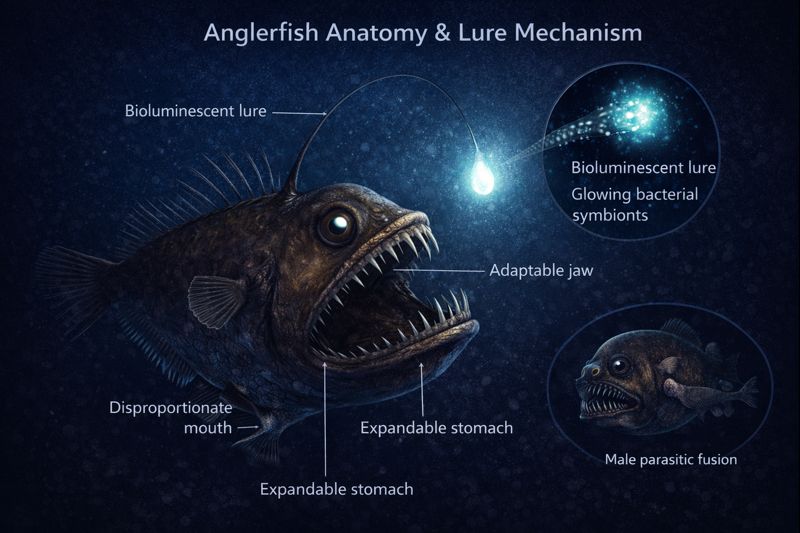
A bioluminescent lure is brilliant! This is the strategy of anglerfish—sit motionless in darkness, dangling a glowing lure, and wait for prey to come to you. This completely eliminates pursuit costs in an environment where chasing prey would burn precious energy. It's an ambush strategy perfected for the deep sea. The lure is actually a modified dorsal fin spine colonized by bioluminescent bacteria. Some of the most successful deep-sea predators use this exact adaptation!
✅ Excellent choice!
Slow metabolism is absolutely essential! In the energy-starved midnight zone, organisms must stretch every calorie. Deep-sea fish have metabolic rates a fraction of surface fish. They grow slowly, reproduce rarely, and move as little as possible. Some can survive six months or more without eating. Cold temperatures help—reactions slow down, reducing energy needs. This isn't optional; it's the fundamental strategy that makes life possible here. You've identified the most universal adaptation in the deep sea!
Creatures of the Abyss
Deep-sea creatures have evolved adaptations that seem pulled from science fiction. Many have enormous eyes to capture any trace of bioluminescence. Others have abandoned vision entirely, navigating by touch and smell. Bodies tend to be gelatinous—firm structures would collapse under pressure. Mouths and stomachs can expand to swallow prey larger than themselves, because meals are too rare to waste.
Figure 3
Anglerfish anatomy reveals extreme adaptations for life in the food-scarce midnight zone: a bioluminescent lure powered by bacterial symbionts attracts prey, while a disproportionate mouth, adaptable jaw, and expandable stomach allow them to consume meals larger than themselves. Inset shows the bizarre male parasitic fusion.
Predator
🐟 Anglerfish
Females carry bioluminescent lures dangling from their heads. Males are tiny—only a few centimeters—and fuse permanently to females, becoming living sperm banks. Some females carry multiple parasitic males.
Giant
🦑 Giant Squid
Eyes the size of dinner plates—the largest in the animal kingdom—evolved to detect the faint glow of sperm whales hunting in the darkness. Can reach 13 meters in length.
Deep Dweller
🐙 Dumbo Octopus
Lives at depths over 4,000m, flapping ear-like fins to drift above the seafloor. Swallows prey whole—no time to be picky when food is this scarce.
Scavenger
🦐 Giant Isopod
Pill bugs the size of footballs that can survive years without eating. When food arrives—like a whale carcass—they gorge until they can barely move.
Undiscovered Species
The deep sea is the largest museum of undiscovered species on Earth. We find new ones almost every time we look. Scientists estimate that 90% of deep-sea species remain unknown to science. Every expedition returns with creatures never before seen by humans.
🔗
Connection Challenge
Explain how hydrothermal vents support life without any sunlight. Tap key phrases below to build your answer:
Energy source:
Chemical process:
Organisms:
Your answer:
Tap phrases above to build your explanation...
🌟 Sample Connection
Hydrothermal vents release superheated water rich in chemicals like hydrogen sulfide. Bacteria use chemosynthesis—converting these chemicals into energy instead of using sunlight. These bacteria form the base of a food web that supports giant tube worms, eyeless shrimp, and entire ecosystems independent of the sun. This represents life finding an entirely different energy source.
Your answer might have focused on different aspects and that's perfect! The key is understanding that chemosynthesis replaces photosynthesis as the energy foundation in these remarkable oases.
Oases in the Desert
The deep seafloor isn't uniformly barren. Certain features concentrate life in densities that rival coral reefs—hydrothermal vents, cold seeps, whale falls, and seamounts create islands of abundance in the desert of the deep.
🌋 Hydrothermal Vents
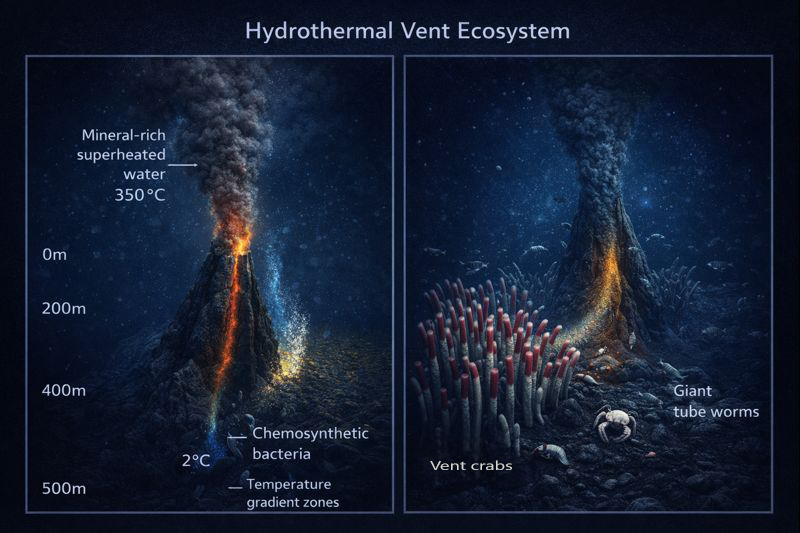
Where tectonic plates spread apart, superheated water rich in chemicals erupts from the seafloor. Water reaches 400°C—hot enough to melt lead. Here, bacteria harvest energy not from sunlight but from chemical reactions—chemosynthesis instead of photosynthesis. These bacteria form the base of food webs that support giant tube worms (up to 2 meters long), eyeless shrimp, and strange crabs in a world entirely independent of the sun.
Ecosystem
Chemosynthetic Life
Bacteria oxidize hydrogen sulfide to produce energy, just as plants use sunlight. Tube worms host billions of these bacteria in their tissues, receiving nutrients in exchange for shelter.
Discovery
Unexpected Abundance
When vents were discovered in 1977, scientists were shocked to find thriving ecosystems. Before this, we thought all life ultimately depended on photosynthesis.
Other Oases
Whale Falls
When a whale dies and sinks, its carcass creates an ecosystem that can persist for 50 years. Specialized species have evolved to exploit these rare bonanzas.
Methane Seeps
Cold Seeps
Methane and hydrogen sulfide seep from the seafloor, supporting chemosynthetic communities that can persist for centuries without any sunlight.
Figure 4
Hydrothermal vent ecosystems thrive in complete darkness, powered by chemosynthesis rather than sunlight. Superheated water (350°C) meets near-freezing seawater (2°C), supporting communities of giant tube worms, vent crabs, and chemosynthetic bacteria—life independent of the sun.
🔍
Check Your Understanding
Based on what you just read about hydrothermal vents, which statements are accurate? (Select all that apply)
Bacteria use chemosynthesis instead of photosynthesis to produce energy
These ecosystems are entirely independent of sunlight
Vent organisms migrate to surface waters to feed at night
Water temperatures at vents can reach 400°C
Correct selections
Hydrothermal vents represent a fundamentally different form of life. Chemosynthetic bacteria harvest energy from chemicals like hydrogen sulfide, supporting entire ecosystems without any connection to photosynthesis or sunlight. Water reaches extreme temperatures (400°C+), yet organisms thrive just centimeters away in cooler zones. Vent organisms don't migrate—they're permanently attached or confined to the vent system.
The Carbon Highway
The strategies for survival in the midnight zone push biology to its limits. Many deep-sea fish have dispensed with swim bladders—gas compresses under pressure, making buoyancy control impossible. Instead, they have watery flesh and reduced skeletons to achieve neutral buoyancy. Some have antifreeze proteins in their blood. Others can slow their metabolism so dramatically they seem barely alive.
Key Insight
The midnight zone demonstrates that life is far more adaptable than we ever imagined. Where we see impossibility—crushing pressure, eternal darkness, near-freezing temperatures, food scarcity—evolution finds solutions. These organisms aren't just surviving; they're thriving in Earth's largest habitat. Understanding them expands our conception of where life can exist, both on Earth and potentially on other worlds.
Threats to the Deep
For centuries, the deep ocean seemed too remote for human impact. We were wrong. Deep-sea mining threatens to destroy vent communities that took millennia to develop. Bottom trawling scrapes the seafloor clean. Plastic and pollutants sink to the deepest trenches. Climate change is altering deep water chemistry and temperature.
The midnight zone's remoteness once protected it. That protection is ending. We face a choice: will we explore and understand the deep before we destroy it, or will we lose species and ecosystems we never even knew existed?
🤔
Pause & Reflect: Ocean Stewardship
The midnight zone remained untouched for millions of years. Now, human activities—deep-sea mining, bottom trawling, plastic pollution—are reaching even the deepest trenches. Consider this question:
Should we prioritize exploring and understanding the deep ocean before we exploit it, or is economic development more urgent? What ethical principles should guide our decisions about ecosystems we've barely begun to study?
This is one of the great ethical questions of our time. The deep sea contains resources we might need—rare minerals, potential medicines, even insights into the origins of life. But it also contains ecosystems that took millions of years to evolve, species found nowhere else, and processes we don't yet understand.
Some argue that the precautionary principle should apply: when we don't know what harm we might cause, we should err on the side of protection. Others counter that responsible development can coexist with conservation. Perhaps the answer lies in thorough scientific assessment before any exploitation, establishing marine protected areas, and requiring that economic activities prove they won't cause irreversible harm.
What's certain is that once destroyed, these ecosystems cannot be restored in any human timeframe. The decisions we make now will determine whether future generations inherit an ocean as rich and mysterious as the one we've barely begun to explore.
Knowledge Check
Validate your understanding of the midnight zone
1
Which of the following are characteristics of the midnight zone? (Select all that apply)
It extends from 1,000 to 4,000 meters depth
Pressure at 4,000m reaches approximately 400 atmospheres
Faint sunlight still penetrates to provide some illumination
It contains Earth's largest habitat by volume
Correct selections
The midnight zone (bathypelagic) spans 1,000-4,000m and represents Earth's largest habitat. At 4,000m, pressure reaches about 400 atmospheres. No sunlight penetrates here—it's absolute darkness. The only light comes from bioluminescent organisms.
2
Why is food scarcity the PRIMARY limiting factor in the midnight zone? (Select all that apply)
Most food arrives as "marine snow" drifting down from above
No photosynthesis occurs, so no local food production
Extreme pressure prevents organisms from digesting food
Prey density is extremely low compared to surface waters
Correct selections
Food scarcity defines the midnight zone. With no sunlight for photosynthesis, all energy must fall from above as marine snow or occasional whale carcasses. Prey are sparse and scattered. While organisms have adapted to pressure, cold, and darkness, the energy shortage shapes every aspect of deep-sea life—slow growth, minimal movement, expandable stomachs.
3
What makes hydrothermal vent ecosystems unique? (Select all that apply)
They rely on chemosynthesis instead of photosynthesis
They are completely independent of sunlight
Organisms migrate daily to surface waters to feed
Bacteria harvest energy from chemicals like hydrogen sulfide
Correct selections
Hydrothermal vents revolutionized our understanding of life. Chemosynthetic bacteria use chemical energy (hydrogen sulfide, methane) instead of sunlight, creating ecosystems entirely independent of photosynthesis. Before 1977, we thought all life ultimately depended on the sun. Vent organisms don't migrate—they're permanently attached or confined to the vent system.
4
Which adaptations help organisms survive in the midnight zone? (Select all that apply)
Gelatinous bodies without rigid structures that would collapse under pressure
Expandable stomachs to consume prey larger than themselves
Fast metabolism to quickly process rare food when found
Extremely slow metabolism to survive months without eating
Correct selections
Deep-sea survival demands flexibility and efficiency. Gelatinous bodies handle pressure without rigid structures. Expandable stomachs let organisms consume huge meals when opportunities arise. Slow metabolism—not fast—is key: organisms must stretch every calorie across weeks or months. Many have eliminated swim bladders (gas would compress), achieving neutral buoyancy through watery tissues.